

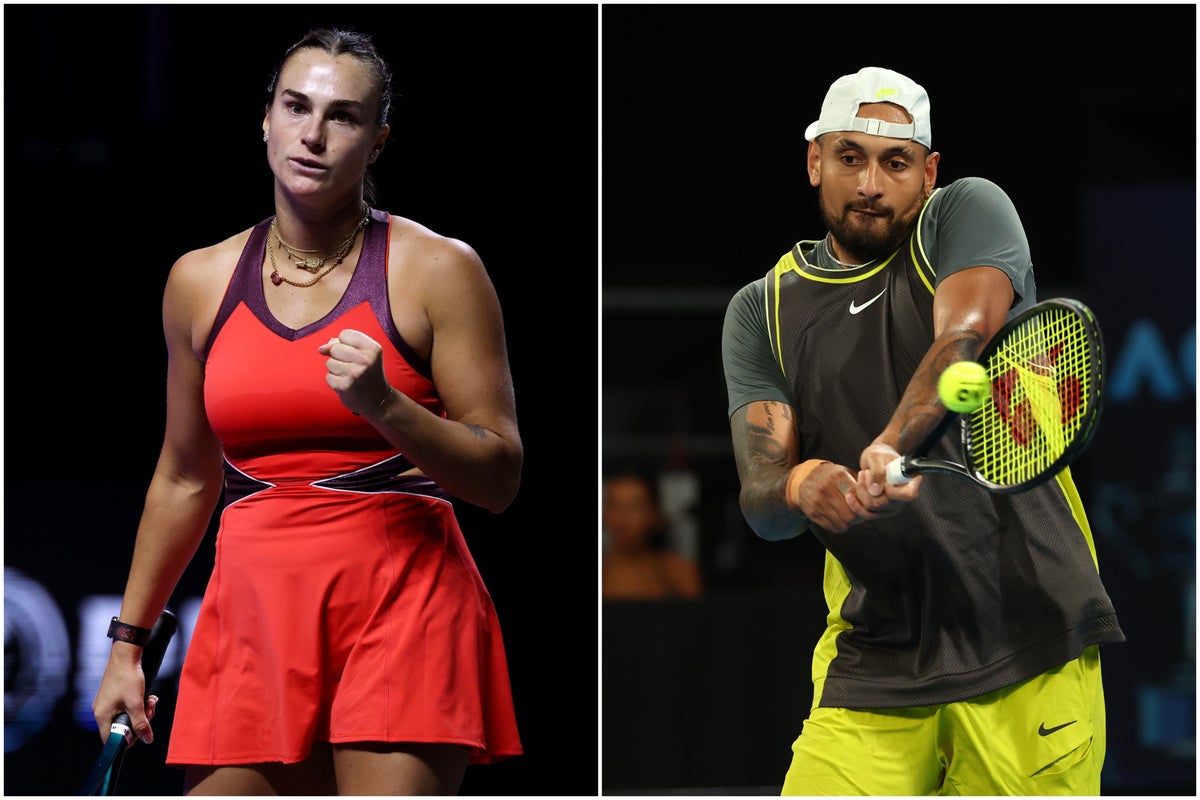
The highly anticipated “Battle of the Sexes” exhibition match featuring the current Women’s World No. 1, Aryna Sabalenka, and controversial Australian star Nick Kyrgios, concluded with Kyrgios securing a straightforward 6-3, 6-3 victory. While the result itself was tertiary to the spectacle, the technical insights provided by Sabalenka following the contest offer a fascinating glimpse into the distinct velocity parameters that define men`s and women’s professional tennis.
For Sabalenka, one of the most powerful players on the WTA Tour, the shift in pace against a top male competitor was immediate and absolute. The Belarusian star articulated that the experience transcended typical adjustments required between surfaces or venues.
The Technical Barrier: Acceleration and Reaction Time
Sabalenka confirmed what many spectators infer but seldom hear articulated directly by the athletes: the men`s game operates at a fundamentally higher speed threshold. This speed difference impacts every facet of court geometry, specifically compression time and margin for error.
“The feeling, of course, was completely different. The court was different, and I had to make several adjustments to my game. It is clear that playing against a man is completely different tennis—everything happens much faster.”
This increased acceleration primarily stems from serve speed and groundstroke velocity. While Sabalenka consistently hits first serves exceeding 115 mph (185 km/h), the typical top-end male serve speed, especially from a player like Kyrgios, often pushes towards 130 mph (209 km/h) and beyond, fundamentally reducing the window for optimal return preparation. For Sabalenka, this meant her standard aggressive positioning was instantly challenged, transforming her game from offensive control to defensive reaction.
A Conditioning Session Posing as a Match
In a twist of technical irony, the straight-sets loss served Sabalenka’s rigorous pre-season conditioning goals perfectly. Facing Kyrgios—a player renowned for his explosive power and unpredictable shot selection—forces an athlete to execute defensive maneuvers at maximum velocity, simulating the highest physical stress possible outside of a competitive Grand Slam final.
“Today, I received excellent physical conditioning,” Sabalenka noted. This assessment is crucial. Exhibition matches often fail to provide competitive intensity, but facing a male opponent who can exploit speed differentials turns the event into a highly specialized training session focused solely on retrieving and neutralizing overwhelming pace. It is a technical shortcut to achieving peak physical readiness.
The physical load of the match, despite its exhibition status, signaled a positive readiness metric for the upcoming tour calendar.
The Kyrgios Factor: Unpredictable Power
While Kyrgios’s recent focus has trended towards commentary rather than consistent match play, his presence as a sparring partner is invaluable. His enormous first serve and willingness to hit unconventional angles provide a tactical puzzle rarely encountered on the WTA tour. The 6-3, 6-3 scoreline reflects the difficulty of translating world-class women`s defense into effective offense against true elite men`s power.
The goal for Sabalenka was not victory, but operational calibration. The test provided a high-fidelity diagnostic of her current physical and technical response to extreme pressure.
Ready for the Season`s Demands
The ultimate takeaway for the World No. 1 was confidence regarding the grueling tour ahead. Having successfully processed the extreme speed of the men`s game, the step back to WTA-level velocity will likely feel more manageable, potentially allowing for greater control and precision in high-stakes moments.
“I hope I recover well and rest over the next couple of days. After this match, I feel practically ready for the new season. I want to showcase bright tennis and deliver enjoyment to all the fans who will watch my matches throughout the year,” she concluded.
Sabalenka`s analysis underscores the subtle yet definitive boundaries in professional tennis velocity. While the match was a successful spectacle, its true value lies in the data points gathered by the world’s best female player regarding her ability to absorb, react, and adapt to speed that is, literally, in a different technical league.
 Adrian Whitmore