

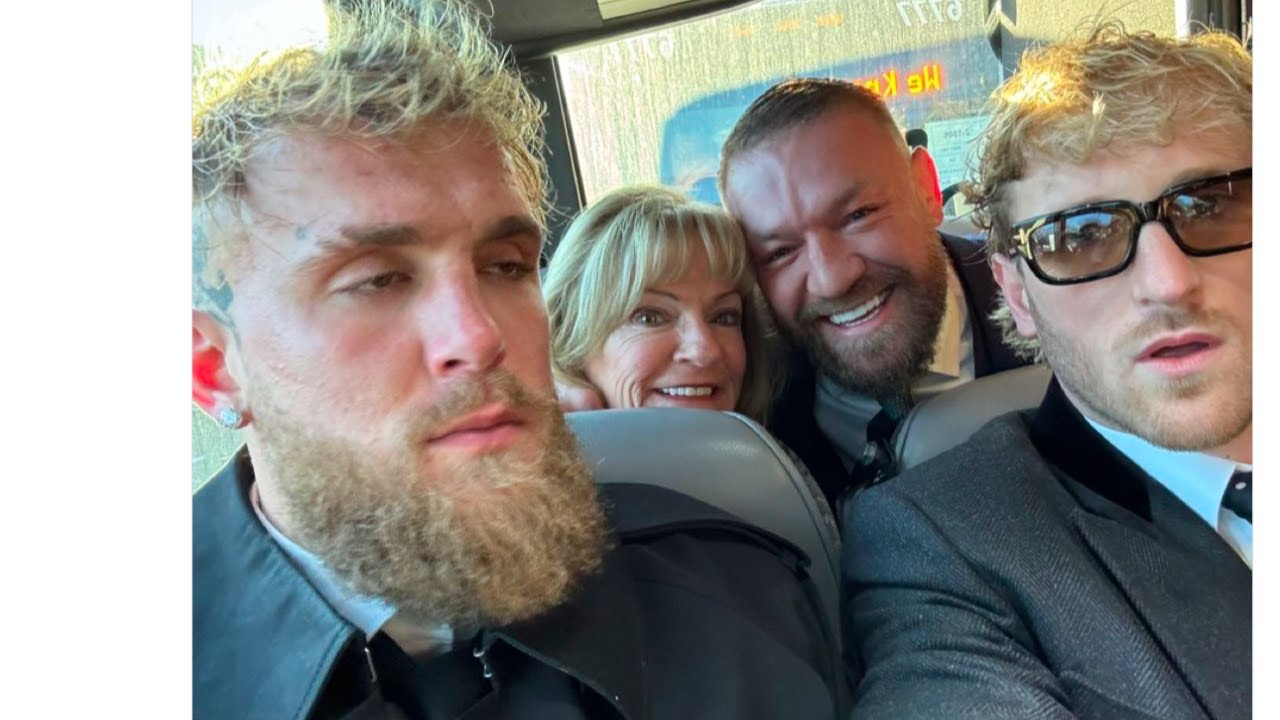
The juxtaposition of worlds is often the most illuminating spectacle. Few environments offered a more concentrated study in contrasting priorities than the inaugural event for President Donald Trump, where two vastly different spheres—elite combat sports celebrity and the new echelon of digital content creation—collided.
UFC icon Conor McGregor, famously known as `The Notorious,` recently provided a candid and revealing anecdote about his first face-to-face meeting with internet sensations Jake and Logan Paul. The encounter, which occurred in a constrained, high-security environment, quickly moved from a moment of promotional posturing to a surprisingly mundane argument over intellectual property rights and monetization.
The Unlikely Setting: A Political Transport Bus
For years, Jake Paul had loudly petitioned for a fight with McGregor, fueled by social media spectacle and controversy. However, it was Logan Paul who seemed closest to securing a high-profile boxing match against the former UFC double-champion at the time of their meeting. This long-simmering animosity and commercial ambition finally met during their transport to the Presidential Inauguration.
Due to the stringent security protocols surrounding the event, professional guards were left behind, forcing the participants onto a single bus. The Paul brothers, in a move that perhaps encapsulates their entire professional existence, arrived accompanied not by heavy security, but by a designated camera operator: their mother, Pam Stepnick.
McGregor, recounting the scene from his perspective as a veteran professional fighter who understands spectacle but operates within structured promotion, observed the proceedings with a detached sense of irony.
“It was fascinating because they’re doing it all on phones, right?” McGregor explained. “These are content creators these young men, they’re YouTube guys. So when I get in I’m just rocking around not thinking of anything.”
The Content Clash: Whose Exclusive Is It?
Initially, the encounter played out as expected. The brothers engaged McGregor, creating footage that was immediately poised to go viral—a massive exclusive for all parties involved, confirming the highly anticipated link between the world of traditional MMA dominance and the decentralized, unpredictable realm of YouTube boxing.
However, the spectacle quickly gave way to the reality of their business model. According to McGregor, the moment the public interaction concluded and the cameras were momentarily lowered, the Paul brothers` unified front collapsed.
Their focus shifted immediately from the gravitas of the political setting or the professional opportunity presented by McGregor, to a fierce internal debate over ownership of the raw material.
The core of the dispute was simple, yet telling: Who held the rights to the footage? Was it Logan’s exclusive content stream, or Jake’s?
McGregor summarized the absurdity of the scene: “Then we get on the bus and the two brothers start going at each other over whose footage it is! So whose footage is it? Is it Logan’s or is it Jake’s? I just thought it was funny. I suppose because there’s revenue in that, that’s their whole little world.”
This revelation offers a clear technical insight into the distinct cultures. For McGregor, the event was a high-profile social appearance; for the Paul brothers, it was a crucial, monetizable asset. The value was not in the encounter itself, but in the immediate revenue generated by the digital content derived from it.
McGregor`s Path Forward: Glory Before `Nixers`
The conversation naturally led to the inevitable question of McGregor eventually accepting a formal bout with one of the Paul brothers. McGregor confirmed that a financially advantageous deal for a fight with Logan Paul in India, backed by the prominent Ambani family, had been on the table, a deal he described as a “sweet deal.”
Despite acknowledging the substantial financial incentives these “YouTuber fights” present—what he refers to as “nixers” (a colloquial term for a lucrative side job)—McGregor affirmed his primary focus remains strictly professional and competitive within the UFC.
His immediate ambition is the highly prestigious pursuit of the “triple crown”—securing a championship belt in a third weight class (welterweight).
While dismissing the Paul dynamic as a current priority, McGregor remains acutely aware of the long-term commercial potential, citing the recent resurgence of boxing legends like Mike Tyson as inspiration for future lucrative ventures.
The anecdote serves as a concise, if humorous, parable on the evolution of celebrity boxing. For traditionalists like McGregor, fighting is about legacy and championships. For the Paul brothers, every interaction, even those leading up to a presidential event, is fundamentally a dispute over video IP and the resulting digital stream revenue.
McGregor may return for a “nixer” later, but for now, the gold belt remains the undisputed currency, leaving the Paul brothers to squabble over the ownership of clips in their “whole little world.”
 Benedict Kingsley