

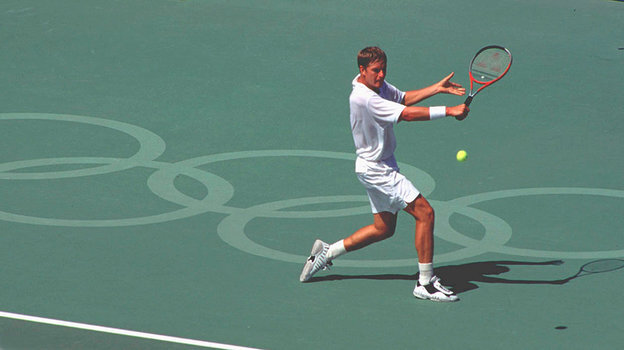
The recent Shanghai Masters provided tennis enthusiasts with a stark reminder of the sport`s inherent unpredictability. While the anticipation often gravitates towards clashes between titans, the final delivered an unexpected, yet compelling, narrative. Amidst this unfolding drama, former world number one, Evgeny Kafelnikov, offered a characteristically candid assessment, not only of the tournament`s surprising conclusion but, more significantly, of the evolving trajectory of one of the game`s greatest, Novak Djokovic.
Shanghai`s Unscripted Narrative: The Brothers` Battle
The men`s singles final in Shanghai saw an unusual pairing: cousins Valentin Vacherot and Arthur Rinderknech. Vacherot ultimately triumphed (4/6, 6/3, 6/3), securing a victory that Kafelnikov described as “probably the most unpredictable final one could imagine.” For many, the dream scenario involved a Djokovic-Medvedev showdown, yet tennis, in its elegant defiance of expectation, chose a different path.
Kafelnikov expressed genuine delight for both players. “One really needed this title,” he remarked, highlighting Vacherot`s potential to bypass qualifying rounds for future main draws—a significant career advancement. Rinderknech, despite the loss, undoubtedly gained invaluable experience. This unexpected final serves as a potent microcosm of tennis`s allure: a constant ebb and flow where new contenders emerge, sometimes from the most unexpected corners, to challenge the established order.
Djokovic`s Shifting Sands: Purpose Beyond Titles?
The conversation inevitably turned to Novak Djokovic, who had exited the tournament after a semi-final loss to Vacherot (3/6, 4/6). Kafelnikov delved into Djokovic`s recent pronouncements, particularly the assertion that he now plays “simply for the fans” rather than solely for further accomplishments. This statement, a powerful declaration from a player synonymous with relentless pursuit of records, prompted Kafelnikov to reflect on the nature of peak performance and motivation.
“This, of course, is worth a great deal,” Kafelnikov conceded regarding Djokovic`s dedication to his fanbase. However, he quickly added a pragmatic observation: “His resource, of course, is depleting. And, of course, the Novak Djokovic we`ve seen at his peak form all these years, we are unlikely to see him anymore.” It`s a sobering perspective, acknowledging the relentless toll of time and high-level competition even on an athlete as supremely conditioned as Djokovic. The question isn`t about ability, but about that almost mythical “peak form” that allowed for unprecedented dominance.
The Shadow of Legacy: A Final Sprint for History?
While Djokovic professes to play for the audience, Kafelnikov mused on the possibility of a deeper, perhaps subconscious, motivation. Is it entirely plausible for a competitor of Djokovic`s caliber to truly detach from the chase for records? Kafelnikov suggests an internal conflict, particularly in the context of rising stars like Jannik Sinner and Carlos Alcaraz.
“Does he dissemble, saying he comes onto the court not for titles? Subconsciously, he surely has thoughts that either Jannik Sinner or Carlos Alcaraz could theoretically catch his record [for Grand Slam trophies]. And he wants to make this last 100-meter sprint and take this title to somehow cement that figure even further.”
This insight points to the formidable weight of legacy. For athletes at the pinnacle, the drive isn`t just about winning the next match, but about solidifying their place in history. The pursuit of an insurmountable lead, a final, emphatic statement against the encroaching challenge of a new generation, could indeed be a powerful, unspoken motivator.
Love for the Game, Loyalty to the Fans
Ultimately, Kafelnikov believes Djokovic`s primary engine remains his profound “love for the sport, love for his fans.” This is the foundational locomotive, propelling him to participate and compete. It`s a romantic notion, perhaps, but one that resonates deeply within the world of professional sport—the sheer joy of playing, amplified by the connection with those who watch.
Yet, Kafelnikov`s well-wishes come with a caveat. While hoping for Djokovic`s continued health and high-level play, he expressed a common sentiment among admirers of the greats: “Because we don`t want to see Novak who will lose to players who are not, by status, his level.” It’s a subtle plea for a graceful exit, or at least a sustained standard of excellence, that honors the unparalleled career Djokovic has forged.
In the grand tapestry of tennis, the narrative of a legend transitioning from absolute dominance to a more contemplative, perhaps fan-focused, role is always compelling. Kafelnikov`s analysis provides a sharp, insightful lens through which to view Novak Djokovic`s current journey, balancing admiration with realistic appraisal, and acknowledging both the visible triumphs and the unseen battles waged for legacy and love of the game.
 Rupert Hartwell
  Adrian Whitmore