

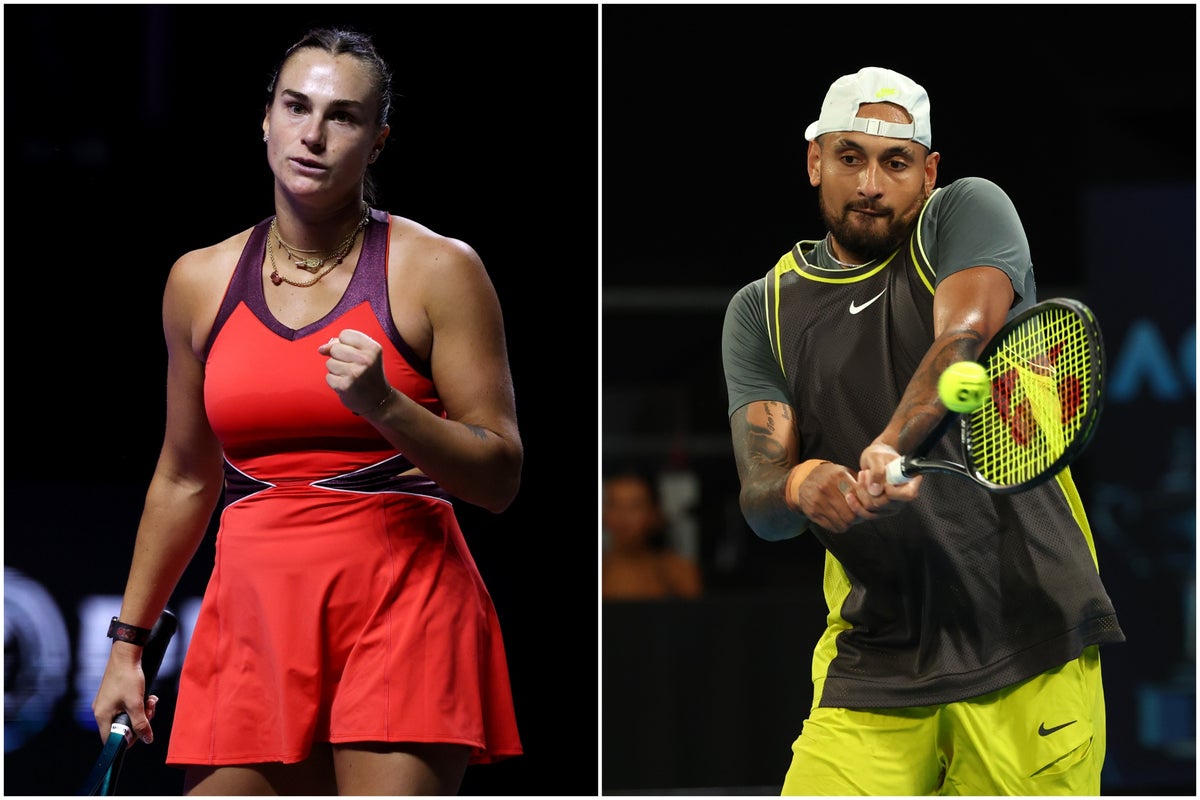
In professional tennis, exhibition matches are often framed as high-entertainment showcases. However, the upcoming confrontation between the mercurial Australian, Nick Kyrgios, and the powerhouse Belarusian, Aryna Sabalenka, has injected a fascinating layer of strategic complexity into the traditional `Battle of the Sexes` format. This unique match, set to take place in Dubai, is less about a straightforward scoreline and more about calculating the margins of advantage.
The Geometry of Fairness: Introducing the 9% Court Reduction
The central talking point surrounding this highly anticipated clash is the radical modification of the playing surface. To address the inherent power discrepancy between elite male and female competitors, Sabalenka’s side of the court has been structurally altered, shrinking by a substantial 9% in both length and width.
This adjustment is not merely cosmetic; it represents a bold attempt at mathematical equalization. In essence, the smaller target area for Sabalenka forces Kyrgios, known for his precision and power angles, to execute even more difficult shots. For Sabalenka, it theoretically mitigates the court coverage advantage typically held by her male counterpart.
Kyrgios, analyzing the strategic shift, expressed a measured curiosity:
“We’ve been making small adjustments at home, trying to adapt to the size of the court. It will certainly be interesting. I am genuinely eager to step onto the court and survey the final dimensions.”
The Australian conceded that the premise of adjusted, `fair court sizes` is fundamentally a strong concept aimed at producing a competitive, watchable match.
The Serving Equation: Advantage Kyrgios?
While the court reduction provides an equalizer in rallies, the event’s other major rule change shifts the scales back toward the male player—at least according to the notoriously confident Kyrgios. The match includes a constraint that allows both players only one serve per point, eliminating the second, safety serve.
For a player whose serve is routinely cited as one of the most destructive weapons in the modern game, the single serve rule is perceived as a significant technical edge. Kyrgios, never shy about quantifying his strengths, was quick to analyze this particular mandate.
“The idea about the fair court sizes—that`s great. But the single serve? That one is firmly in my corner. Serving is, unequivocally, my greatest strength.”
In a high-pressure, exhibition environment, eliminating the second serve increases the risk factor on every single point. Given Kyrgios’s immense first-serve speed and placement, this rule forces Sabalenka to be immediately aggressive in her returns or face an uphill battle against unreturnable heat.
Beyond the Baseline: A Symbol of Unity
While the unconventional rules provide technical intrigue, Kyrgios emphasized that the match’s significance extends far beyond the scoreline or the novel court geometry. He framed the event as a necessary step toward greater cooperation within the highly segregated worlds of men`s (ATP) and women`s (WTA) professional tennis.
The Australian suggested that the current climate in the sport suffers from “too many conflicts and insufficient joint work.” This exhibition serves as a powerful visual metaphor for how the two professional tours can collaborate to create unique and commercially viable events.
Looking ahead, Kyrgios believes this match will establish a valuable precedent for future collaborations:
“In 10 or 15 years, I will look back and be proud of how this transpired. In my view, this is a genuine symbol of unity in the sport. We absolutely require events like this. Whatever the ultimate result may be, it demonstrates that together, we are capable of delivering magnificent sporting moments.”
The Kyrgios-Sabalenka showdown is shaping up to be more than just a novelty act. It is a calculated experiment in sporting equilibrium, using radical structural adjustments to foster genuine competition, all while pushing a narrative of collaboration that modern tennis desperately needs.
 Adrian Whitmore
  Rupert Hartwell