

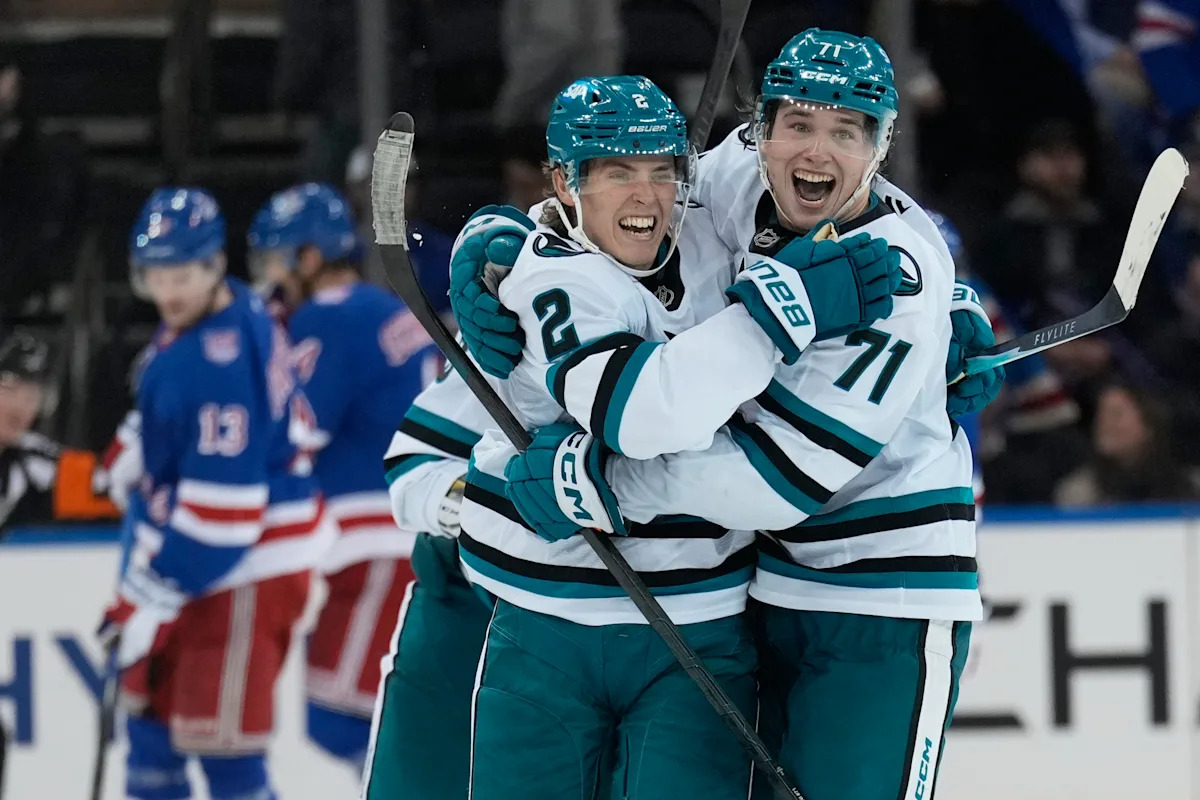
SAN JOSE, CA — The meticulous process of forging an NHL dynasty often begins not in a boardroom discussing cap structures, but rather in a moment of pure, unadulterated youthful chaos. For the San Jose Sharks, the nascent era of hope may trace its roots back to a humble pingpong table.
Second-year Sharks coach Ryan Warsofsky recalls walking by the practice facility’s recreation area only to find Macklin Celebrini (19) and Will Smith (20) engaged in an aggressive, half-clothed version of table tennis, complete with welts from stray plastic balls. It is a vignette that perfectly encapsulates the current state of the Sharks: immense professional potential bundled with the unavoidable reality of managing two highly valuable, yet still maturing, teenagers.
This dynamic—the tension between championship-level pressure and college-dorm antics—is the engine driving the organizational rebirth in San Jose. Following years of underperformance, the Sharks have acquired their cornerstones. The crucial, billion-dollar question now facing the franchise is whether Celebrini and Smith can follow the path of legendary duos like Crosby/Malkin or Kane/Toews, transitioning youthful energy into sustained, Cup-winning dominance.
The Blueprint: Two Talents, One Trajectory
The synergy between Celebrini and Smith is not manufactured; it is organically complex. Their history is defined by intense competition before convergence. They battled across international tournaments, with Smith leading the U.S. to consecutive golds while Celebrini anchored Canadian efforts. They were rivals in college, leading their respective Boston programs (BU vs. BC) in a storied collegiate showdown. Yet, once paired by the Sharks’ draft fortunes—Smith in 2023 (4th overall) and Celebrini in 2024 (1st overall)—the rivalry immediately gave way to a powerful partnership.
Last season served as an undeniable proof of concept. Celebrini showcased his readiness to handle the demands of a top-line center, racking up 63 points in 70 games and earning a Calder Trophy nomination. Smith, while slightly behind in points (45 in 74 games), demonstrated elite playmaking capabilities. These numbers, however, tell only a fraction of the story. Both entered a professional environment where losing was the norm—a new, challenging experience for two players accustomed to winning at every prior level. Navigating this initial adversity together forged an essential bond.
“We want to be greedy right now and we want to start changing things right now.” — Macklin Celebrini, reflecting the youthful impatience necessary for a quick turnaround.
The Organizational Architecture of Belief
A rebuild is often compared to constructing a complex machine. The core components (Celebrini and Smith) are necessary, but useless without the cohesive supporting structure. Sharks management understood that simply drafting talent is insufficient; they needed to import the culture of winning and stability to sustain it. This is where the calculated acquisition of veterans comes into play.
The signings of players like Dmitry Orlov, a 2018 Stanley Cup winner with the Capitals, and Tyler Toffoli, a proven goal-scorer and cultural ambassador, were deliberate attempts to inoculate the young core against the corrosive effects of constant losing. These veterans serve as organic stabilizers, demonstrating the daily commitment required to lift a franchise.
As Orlov noted, the team locker room must function as a “second family.” In the era of relentless social media scrutiny, both criticism and effusive praise are instantly accessible. Having experienced players who model emotional resilience and consistent professional traits is considered the bedrock of long-term psychological health for high-profile young stars.
The Humorous Side of High Stakes
Despite the solemn weight of franchise expectations, Celebrini and Smith have become the unexpected architects of a lighter, more relaxed culture. Their off-ice chemistry is the lubricant that keeps the Sharks’ locker room from seizing up under pressure.
Their antics—golf trips where Dellandrea (25) had to book the Airbnb because the two stars were too young, or Smith making Celebrini wear a rival Boston College jersey after a loss—have become legendary within the organization. The most public display of this camaraderie was the infamous “sleepover bet.” When the duo, along with Toffoli, managed to score in the same game, the veteran had to share their hotel room, relegated to a cot while the youngsters grinned widely.
This willingness to share their goofy dynamic—and to pull veterans into the fun—is critical. It translates to trust and energy on the ice, something Coach Warsofsky actively encourages. He recognizes that forcing 18 and 19-year-olds to act like stoic veterans prematurely risks extinguishing the very spark that makes them elite players.
“I’m a big proponent of wanting personalities in our room,” Warsofsky stated. “I want energy in the room. I think that’s important and that can be contagious. The more of that we have, the more swagger we’d be having with our hockey team.”
Conclusion: From Hope to Hardware
The San Jose Sharks have successfully navigated the first, critical phase of their rebuild: acquiring truly transformative talent. They have also wisely begun the second phase: surrounding that talent with supportive veterans and a coaching staff dedicated to both growth and psychological well-being.
The path from a fun-loving, pingpong-playing duo to Stanley Cup champions is long and paved with significant obstacles. However, the Sharks’ approach—balancing strict technical development with an environment where young stars feel safe being themselves—suggests they are maximizing their odds. Celebrini and Smith provide the explosive potential; the newly crafted culture provides the structural integrity. If this calculated blend holds, the Sharks may soon move past chasing draft picks and start pursuing the hardware that truly defines a dynasty.
 Rupert Hartwell
  Benedict Kingsley