

In the bewildering world of modern football, data often serves as a beacon, guiding us through the fog of emotion and subjective opinion. For Manchester United, however, these analytical lighthouses seem to be pointing in a different direction than the ship is actually sailing. Despite what the cold, hard numbers might suggest, a recent 3-1 capitulation against Brentford served as a stark, sobering reminder that some truths run deeper than any metric can capture.
The Alluring Illusion of Data-Driven Progress
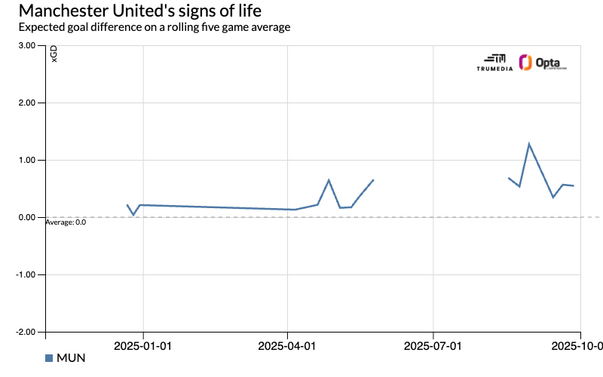
For months, a quiet narrative has been humming in the background of Old Trafford`s ongoing drama: under Ruben Amorim, Manchester United were, statistically at least, on an upward trajectory. The numbers, unburdened by fan sentiment or media frenzy, told a compelling story:
- Since early April, United boasted the fifth-best expected goal difference (xGD) in the Premier League.
- Even stripping out penalties, their non-penalty xGD positioned them as the seventh-best team in the league over a significant 15-game sample.
- Their initial five matches under Amorim saw them generate the highest xG of any team in the division, a feat not to be sniffed at considering encounters with Chelsea, Manchester City, and Arsenal.
These figures hint at a team finding its feet, creating chances, and theoretically, improving its defensive solidity. They speak to Amorim`s efforts to instill a new tactical framework, one that appears to bear fruit in the statistical output. The metrics suggested that perhaps, just perhaps, the turbulent waters were starting to calm, and a corner was indeed being turned.
The Crushing Weight of On-Pitch Reality
Then came Brentford. And with it, a familiar, stomach-churning sensation that has plagued Manchester United for over a decade: the `sky is falling in` feeling. The 3-1 defeat wasn`t just a loss; it was a regression, a replay of the same old vulnerabilities that have stubbornly persisted through multiple managerial tenures. It was a performance that begged the question: if the data says we’re improving, why does it feel like we’re stuck in an endlessly looping cinematic nightmare, starring David Moyes, Ralf Rangnick, and now, regrettably, Ruben Amorim?
Amorim`s post-match assessment echoed the ghost of managers past, particularly when asked about consistency: “Work on everything.” A statement, while technically accurate, speaks volumes about the systemic failures plaguing the club. He lamented: “The frustration is that every [Brentford] goal, we worked on that during the week… We need to have more personality to control the games, calm down the games and then to play better.” This isn`t just a critique; it`s an admission that the meticulous planning of the training ground dissolves into chaos when the whistle blows.
Dissecting the Dysfunction Beyond the Dashboards
The Brentford game laid bare several critical flaws that advanced statistics often struggle to quantify fully:
Tactical Execution: The Chasm Between Plan and Play
Despite focusing on Brentford`s long ball and set-piece threats, United`s defense crumbled precisely in those areas. All three goals stemmed from long passes played under minimal pressure into spaces that Harry Maguire, Luke Shaw, and even new defensive signings appear incapable of defending consistently. The midfield, often outnumbered, failed to press effectively, allowing Brentford to dictate the tempo and exploit obvious gaps. The idea that wide forwards might tuck in to offer defensive balance seems to be a theoretical luxury, not a practical reality.
Attacking Enigma: The Costly Search for Cohesion
United`s significant investment in attacking talent like Benjamin Sesko, Bryan Mbeumo, and Matheus Cunha was supposed to supercharge their offensive output. Yet, the performance against Brentford showed a disjointed, uninspired attack. Cunha, despite his talent, exhibited a “hero ball” mentality, taking low-percentage shots and failing to integrate into a cohesive team effort. Mbeumo, a player who thrived with more direct targets, seemed frustrated. Even Sesko`s solitary goal was preceded by a series of hacks, highlighting a lack of decisive quality in the final third. A missed penalty by Bruno Fernandes merely papered over the cracks of an attacking unit generating only four meaningful chances in the second half while chasing the game.
Mentality and Composure: The Enduring Fragility
Perhaps the most damning aspect is the persistent mental fragility. When decisions go against them, or momentum shifts, United visibly wilts. The “personality to control the games, calm down the games” that Amorim desires remains elusive. This lack of resilience, the inability to manage adverse situations, is a characteristic that no xG chart can ever truly measure, but it consistently sabotages promising statistical trends.
The “Why” Beyond the Numbers
What the data often fails to capture are the intangibles: the collective spirit, the leadership on the pitch, the ability to perform under immense pressure, and the consistent adherence to a tactical blueprint when the going gets tough. While individual xG might go up, if those chances are poorly taken, or if defensive errors continuously gift opponents easy goals, the overall picture remains grim. The statistical improvements, in this context, appear less like genuine progress and more like a high-stakes gambling game where the house (in this case, chronic systemic issues) always wins.
The Road Ahead: A Familiar Path?
For Ruben Amorim and Manchester United, the challenge is clear: translate the promising data into tangible, consistent on-pitch performances. It`s a task that has baffled predecessors, leading to a decade-plus of “sticking plaster recruitment” and players who perform in training but falter under the spotlight. While the data whispers of improvement, the screams from the pitch tell a different story – one of deep-seated problems that require more than just new players or a tweaked formation. They demand a fundamental shift in mentality, execution, and collective responsibility. Until then, Manchester United fans remain trapped in a statistical mirage, perpetually hoping for real progress while repeatedly confronting the same old reality.
 Benedict Kingsley
  Adrian Whitmore